The DST platform recently exceeded the 2.5 million product mark and now counts more than sixty suppliers. “Our platform has developed steadily, and we now serve a large part of the market,” explains DST chairman Remco Tekstra.
The success of DST shows that a collective approach to digitalization in the bicycle industry works well: suppliers, manufacturers, or wholesalers share their product data with retailers and e-commerce players on a single platform. This increases collaboration and efficiency in the chain.
Data: the foundation of the modern bicycle industry
The value of accurate and current product data is increasingly important for all parties in the chain. “We already knew that, and in the Netherlands, we have the advantage of DST and providers of sales statistics such as GfK. That combination ensures that access to current and validated product data is very well organized,” says the DST chairman.

He observes that the bicycle world is internationalizing rapidly, with the rise of the e-bike accelerating this process. “This is also being picked up in Brussels, where we, as a bicycle industry, often sit at the table with other forms of mobility, such as cars and public transport.” According to Tekstra, DST plays a central role in this: “To make the right choices, the chain must have access to reliable and validated product data. DST facilitates this in an independent manner. Our approach is unique: we are a foundation, by and for the industry, with an open standard and a structure of board and expert groups.”
Entire chain benefits
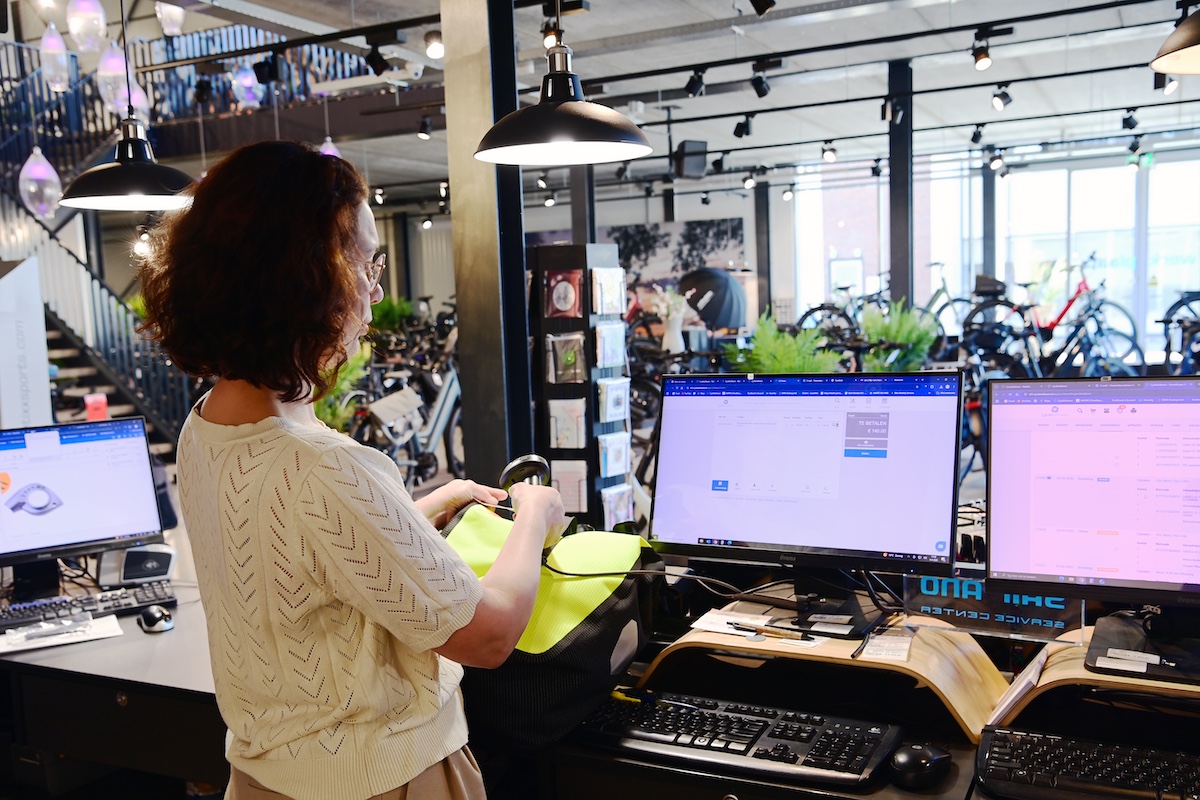
For brands, wholesalers, and suppliers in the bicycle industry, the DST platform offers the solution for intensive digital collaboration in the chain. This ensures efficiency, provides extra opportunities, and saves valuable time. Bicycle shops also benefit from this, both physically and online. Through their POS and point-of-sale systems, DST provides complete and current product information. This allows employees to advise their customers well and find parts or accessories quickly. For a webshop, the same data from DST is crucial for correct product pages, better findability, and a smooth ordering process. In addition, current product data enables efficient purchasing, inventory management, and administration, and prevents delays in warranty or repairs.
Digitalization in the chain offers benefits for everyone
DST makes digitalization concrete and tangible for all parties in the chain:
- Retailers: better findability, higher degree of automation, and better opportunities for e-commerce.
- Suppliers: commercial opportunities, time savings, and support for foreign expansion.
- Point-of-sale systems: offering reliable and current data for daily processes and management information.
Solid foundation and continuous development
“The platform is now firmly established and is therefore a great example of the collective approach,” says Tekstra. “Under the hood of DST 3.0, everything is in good order, with two sprints per year. We work step by step, which also characterizes us a bit. Now it is a matter of further development, listening carefully to the needs of the industry.” In this regard, new life has been breathed into the expert group of suppliers, manufacturers, brands, and POS and point-of-sale systems, further strengthening the collaboration. DST still focuses on the Benelux, where digital processes are largely in order. “We do not primarily have the ambition to become an international platform, but we are not shying away from it either,” says Tekstra. “More and more suppliers are internationalizing and seeing the benefits of scale. One multilingual platform where everything is supplied offers enormous efficiency.”

New positioning and self-service
In addition to a modern platform, DST recently introduced a new corporate identity and website. The latter is more focused on self-support and provides inspiration for suppliers, point-of-sale systems, and retailers. Tekstra explains: “Our service must work invisibly well, and we must also communicate this effectively to interested parties. The renewed website offers a handy resource and more self-service, showing how DST works in practice and what the benefits are for all parties.”
Outlook: data as a building block for the future
DST now has a stable foundation to build on. A next step could be, for example, the collection of sales data. According to Tekstra, data is literally everywhere. “It is a great task for the industry to seize this opportunity. In the United Kingdom and Germany, there are already initiatives to link this data together. With DST, we are now exploring the possibilities of joining in.”
According to him, the industry has a clear direction: “We have now caught up in terms of digitalization and internationalization. Step by step and first in the Benelux, with a focus on the practical and the collective. In this, the importance of data remains consistently high, and the need for it is still growing. DST proves how the industry can work together with a collective approach, from small to large suppliers. The digital future of the bicycle industry is therefore very promising.”